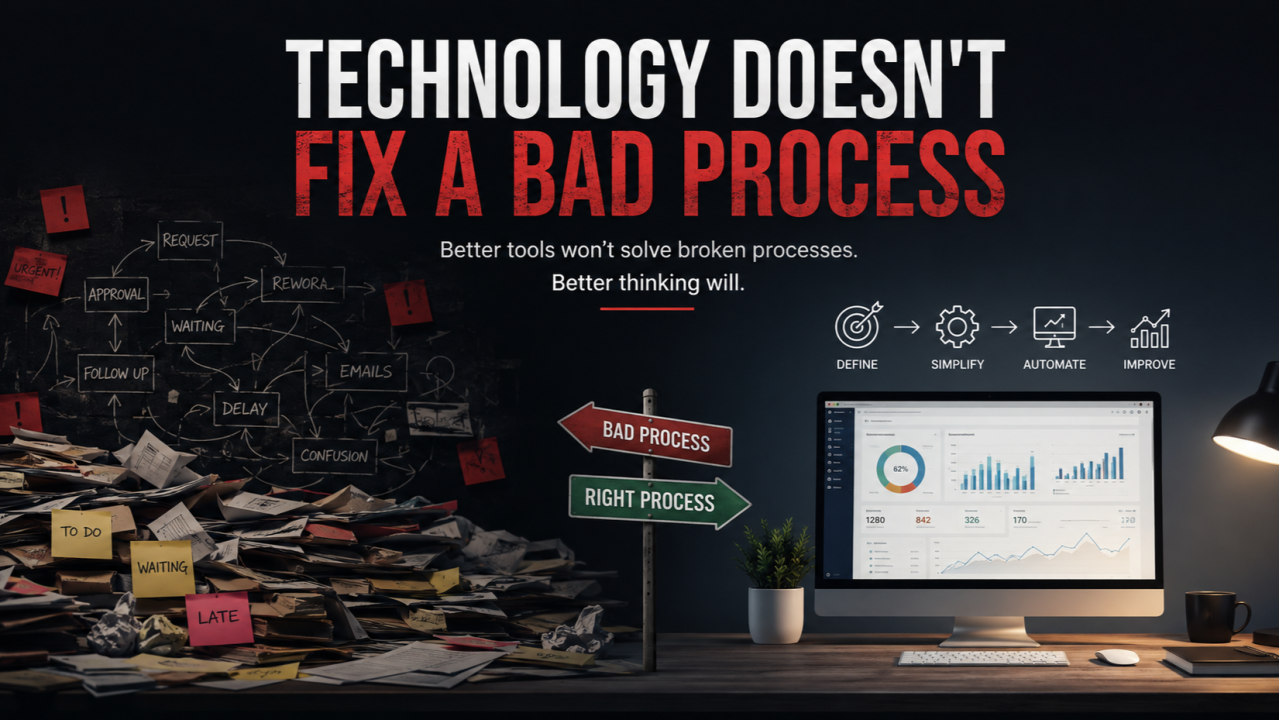
- Technology can improve a process, but it cannot decide whether the process makes sense
- Digitisation is not the same as process improvement
- Before automating, ask: "Should this process exist at all?"
- Growth makes bad processes more expensive, not just bigger
- Technology often exposes management thinking and organisational habits
- Efficiency is about reducing effort for the right outcome, not just speed
- The best technology decisions start with understanding the business, not the software
- People resist technology that makes their existing work harder
- Every process has a cost—even if it doesn't appear on the balance sheet
- Clarity is often the most valuable technology investment before buying technology
A company can spend lakhs on technology and still remain inefficient.
I've seen businesses invest in software, automation, dashboards, cloud systems, digital tools and new platforms - only to discover that people are still doing things almost exactly the way they did before.
The screens look better.
The reports look more professional.
The process is still broken.
That observation has stayed with me because it points to a bigger truth about technology and business:
Technology can improve a process. It cannot decide whether the process makes sense in the first place.
And sometimes, technology makes a bad process harder to notice because it gives the process a modern appearance.
The problem usually starts before the software
Imagine a growing manufacturing company.
A purchase request moves from an employee to a supervisor, then to a manager, then to finance, and finally to the owner.
Nobody is quite sure why every request needs all four approvals.
The company implements a new digital approval system.
Now the request moves through four digital approval screens instead of four physical conversations.
The company has successfully digitised the process.
But it has not improved the process.
This distinction matters.
Digitisation is not the same as improvement.
A manual process can be slow.
A digital process can also be slow.
A spreadsheet can create confusion.
A sophisticated application can create exactly the same confusion at a much larger scale.
The technology is simply following the instructions it has been given.
That is why, before asking, "What software do we need?", businesses should sometimes ask a more uncomfortable question:
"Why are we doing it this way?"
Businesses often automate what they should eliminate
This is one of the most interesting patterns I've noticed.
When a business encounters a repetitive task, the immediate instinct is often to automate it.
But automation should not always be the first step.
Sometimes the right answer is to remove the task.
Sometimes it should be simplified.
Sometimes two steps can become one.
Sometimes nobody actually needs the information being collected.
And sometimes a report that takes three people two hours to prepare every week is being prepared simply because "we have always done it."
Technology can automate that report.
But leadership should first ask whether the report deserves to exist.
This is where technology decisions become business decisions.
A CEO who understands only technology may ask:
"How can we automate this?"
A CEO who understands operations may ask:
"Should this process exist at all?"
The second question can be much more valuable.
The employee sees a different problem
There is another side to this.
Business owners sometimes see inefficiency as an employee productivity problem.
Employees often experience the same inefficiency as a process problem.
Consider an employee who enters the same customer information into three different systems.
From the outside, it may look like the employee is taking too long.
From the employee's perspective, they may simply be following the process they were given.
If management introduces another tool without fixing the duplication, the employee now has four places to update.
The company may call this digital transformation.
The employee may simply call it more work.
That gap in perspective is important.
People rarely resist technology simply because it is technology. They often resist technology that makes their existing work harder.
Good technology should reduce unnecessary effort, not merely move it from one screen to another.
The manager's problem is different again
Managers are often caught in the middle.
They are expected to deliver results, but they also inherit processes created by previous decisions.
A manager may know that a particular approval is unnecessary.
But removing it may feel risky.
What if something goes wrong?
What if someone questions the decision?
What if senior management asks why the control was removed?
So the approval remains.
Not because it adds value.
Because nobody wants to be responsible for removing it.
Over time, businesses accumulate these small decisions.
One approval.
One spreadsheet.
One manual register.
One WhatsApp update.
One email confirmation.
One Excel reconciliation.
One meeting to discuss information that should already be visible.
None of these alone looks serious.
Together, they become the operating system of the company.
And eventually, people start saying:
"Our business is complicated."
Sometimes the business isn't complicated.
The accumulated process is complicated.
Technology exposes management thinking
This is where I think the conversation becomes deeper.
Technology doesn't just change how a company operates.
It often reveals how the company thinks.
If decision-making is unclear, software will expose that.
If ownership is unclear, software will expose that.
If data is inconsistent, software will expose that.
If departments don't communicate, software will expose that.
If nobody knows which information is actually important, dashboards will expose that too.
This can be uncomfortable.
A new system may appear to "create problems" when, in reality, it has simply made existing problems visible.
That is not necessarily a failure of technology.
It can actually be one of its greatest benefits.
Good technology acts like a mirror.
The question is whether leadership is willing to look at the reflection.
One CEO lesson: speed is not the same as efficiency
This is something I often think about.
Businesses sometimes celebrate speed without asking whether they are moving in the right direction.
A team can process 1,000 transactions quickly and still be creating unnecessary work.
A salesperson can enter customer information in seconds and still enter it into the wrong system.
A finance team can generate a report instantly and still be measuring the wrong thing.
A production team can manufacture faster and still produce inventory nobody needs.
Technology can increase the speed of almost anything.
That doesn't automatically make the outcome better.
Efficiency is not doing things faster. It is reducing the effort required to produce the right outcome.
That difference is easy to miss when dashboards start showing impressive numbers.
Another lesson: every process has a cost
Businesses tend to calculate technology costs very carefully.
They compare software subscriptions.
They negotiate implementation fees.
They calculate infrastructure expenses.
But they don't always calculate the cost of the process itself.
What does it cost to get one purchase approved?
What does it cost to correct one data-entry mistake?
What does it cost when a salesperson cannot find the latest customer information?
What does it cost when a manager waits two days for a report?
What does it cost when employees spend their best hours moving information between systems?
These costs rarely appear as a single line item on the balance sheet.
But they are real.
And in a growing company, small inefficiencies multiply.
A process that wastes five minutes may seem irrelevant.
Multiply five minutes across dozens of employees, hundreds of working days and multiple departments, and the business starts paying for that process continuously.
Not through one large invoice.
Through thousands of small losses.
Growth makes bad processes more expensive
A process that works for five people may fail at fifty.
This is normal.
A founder may personally know every customer when the company is small.
Later, that information needs to be shared.
A business owner may approve every purchase personally in the early days.
Later, that becomes a bottleneck.
A team may manage everything through messages when there are six employees.
At thirty employees, information begins disappearing between conversations.
At one hundred employees, the same approach can become operational chaos.
This is why growth requires more than hiring more people.
It requires reconsidering how work moves through the organisation.
Scaling a bad process does not create a bigger version of the old problem. It creates a faster-growing version of it.
Technology can help a company scale.
But the process underneath must be ready to scale too.
The best technology decisions often begin with a whiteboard
Before selecting a platform, I believe there is value in doing something surprisingly simple.
Take a process and draw it.
Who starts it?
Who touches it?
Who approves it?
Where does the information come from?
Where does it go?
Where does it wait?
Where is it entered again?
Where do mistakes happen?
Where does someone have to call another person to ask, "What happened to this?"
And perhaps the most important question:
Which step exists only because nobody has questioned it?
These conversations can reveal more than a technology demonstration.
Because once the process is understood, technology selection becomes much easier.
You are no longer buying features.
You are solving defined operational problems.
Technology still matters — enormously
None of this means technology is unimportant.
Quite the opposite.
The right technology can transform a business.
It can give management visibility.
It can reduce repetitive work.
It can improve collaboration.
It can make information available at the right time.
It can reduce errors.
It can help a growing company operate with greater consistency.
It can allow a small team to accomplish what once required a much larger operation.
But technology works best when it is connected to a clear business objective.
The question shouldn't simply be:
"What can this software do?"
A better question is:
"What should our business be able to do better because of this technology?"
That change in question can completely change the decision.
What I would ask before implementing any major technology
If I were evaluating a new technology initiative, I would want the team to answer a few questions first:
- What problem are we actually trying to solve?
- Is this a process problem, a people problem, a data problem or a technology problem?
- Which parts of the current process genuinely add value?
- Which steps can be removed?
- Who owns the process from beginning to end?
- What information needs to be captured — and what information doesn't?
- What should become faster?
- What should become simpler?
- What should stop happening altogether?
- How will we know that the new process is actually better?
These questions don't require expensive software.
They require clarity.
And clarity is often the most valuable technology investment a company can make before buying technology.
The uncomfortable truth
Sometimes the hardest part of digital transformation isn't implementing the system.
It's convincing people to let go of the old way of working.
Every organisation has habits.
Some are useful.
Some are outdated.
Some exist because they once solved a real problem.
Others exist because nobody has taken the time to question them.
That is why technology projects are rarely purely technology projects.
They involve leadership.
They involve accountability.
They involve culture.
They involve communication.
And above all, they involve the willingness to change how work actually gets done.
A system can be installed in weeks.
Changing the way an organisation thinks about work can take much longer.
That is the real transformation.
The principle I keep coming back to
I've come to believe that one of the biggest mistakes businesses make is treating technology as the starting point.
It isn't.
The starting point is understanding the business.
Understand the customer.
Understand the workflow.
Understand the people.
Understand where decisions happen.
Understand where time is lost.
Understand what information matters.
Then use technology to make that system better.
Not simply more digital.
Not simply more automated.
Better.
Because a bad process with no technology is frustrating.
A bad process with technology is often just a more efficient way of producing frustration.
The real opportunity is not to automate everything.
It is to build a business where fewer unnecessary things need to be done in the first place.
And perhaps that is one of the most important questions leaders can ask before their next technology investment:
"Are we trying to fix the process with technology — or are we using technology to avoid fixing the process?"
The answer can make all the difference.
Explore More Insights
Ready to Build Better Processes?
If your business is ready to move beyond digitisation and improve how work actually gets done, we can help you map, simplify and automate the right way.