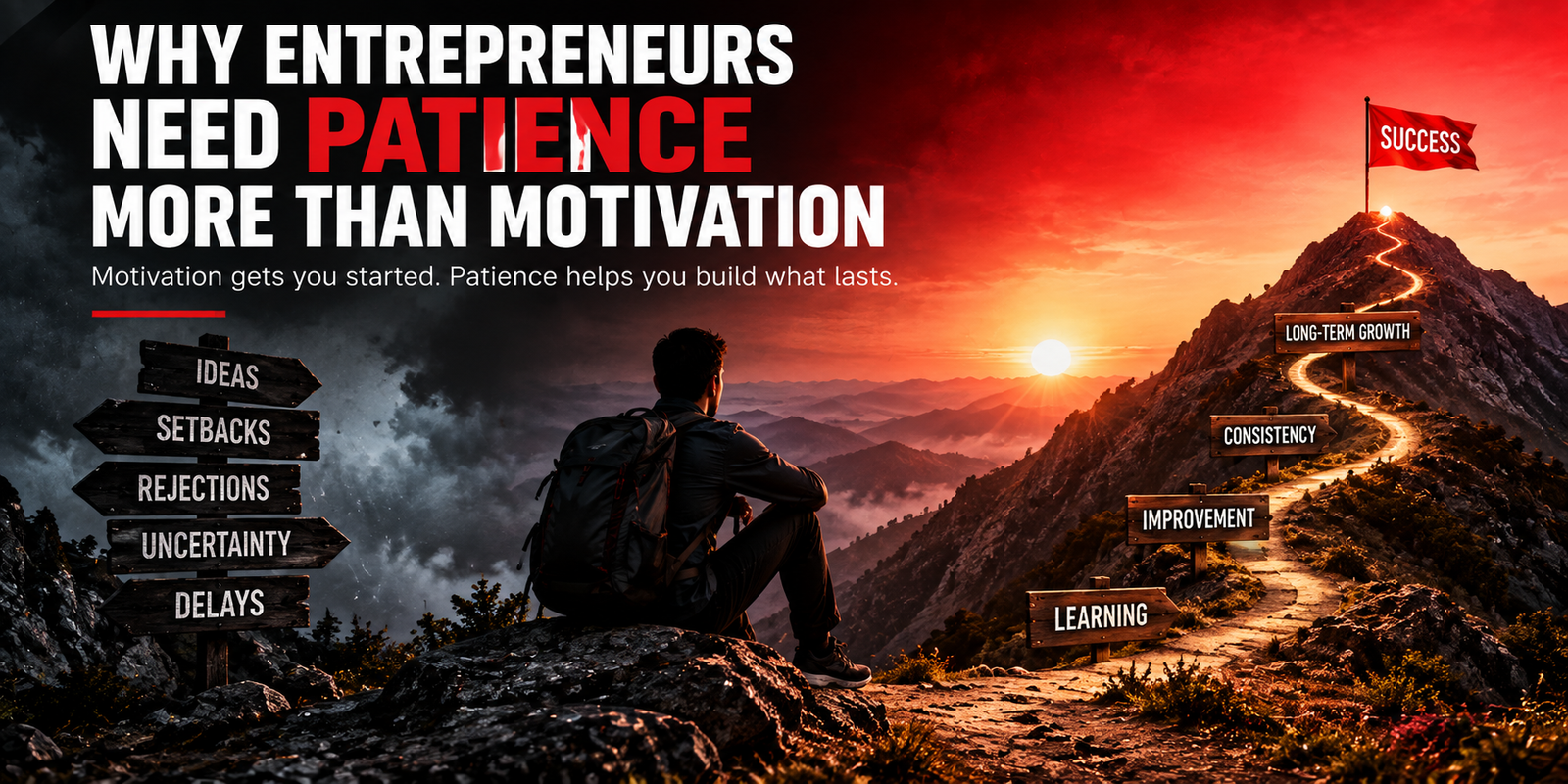
Motivation is easy to find when everything is moving in the right direction.
The real test begins when nothing seems to be happening.
We celebrate motivation in entrepreneurship. We read about founders who wake up at 4 AM. We watch videos about hustle. We follow people who talk about staying hungry and moving fast. There is nothing wrong with any of that - until the energy fades and the results don't arrive on schedule.
Motivation can start the journey. Patience helps an entrepreneur stay committed long enough to learn what actually works.
Read on linkedin: Click Here..
This article is not about staying motivated. It is about something less exciting but more useful: the ability to keep working, learning and adapting when progress is slow, uncertain or invisible.
Motivation Is Useful - But It Has a Short Life
Motivation is valuable. It helps people start, take action and attempt difficult things. But motivation is naturally temporary. It fluctuates based on results, recognition, energy, circumstances and feedback.
An entrepreneur cannot realistically expect to feel highly motivated every day.
One week, everything feels possible. The next week, everything feels difficult. A customer signs and confidence rises. A deal disappears and confidence falls. A product launches with excitement. Sales remain slow and doubt appears.
Building a company requires the ability to continue working even when emotional motivation is low. This is where patience becomes important.
Why Motivation Fluctuates
- Results take time to appear
- Recognition is not immediate
- Energy levels change
- Circumstances shift unexpectedly
- Feedback can be inconsistent
- Financial performance varies
- Personal circumstances affect focus
- External validation is unpredictable
Patience Is Not Sitting Still
Entrepreneurial patience is the ability to continue learning, executing and adapting while accepting that meaningful business results may take time. It is not passive waiting. It is not ignoring problems. It is not refusing to change.
Patience means continuing to learn, observe, measure, improve, experiment, adapt and execute - while accepting that results may take time.
Patience = Action + Learning + Time + Adaptation
Not: Patience = Waiting
The Reality of Slow Business Progress
Business progress is often invisible before it becomes visible. A company may spend months building a product, improving operations, training employees, building relationships, creating systems and understanding customers.
During that period, the visible results may look small. But beneath the surface:
- Knowledge is increasing
- Processes are improving
- Customer understanding is increasing
- Team capability is developing
- Brand trust is building
- Mistakes are being reduced
Not all progress immediately appears as revenue.
Business Does Not Grow in a Straight Line
Entrepreneurs often imagine growth as a straight line: effort leads to results, which leads to more effort, which leads to more results.
But real businesses often look more like this:
Patience helps entrepreneurs continue through the phases where progress is not yet visible.
The Dangerous Expectation of Immediate Results
Modern business culture creates unrealistic expectations. We see overnight success stories, social media entrepreneurs, 30-day growth claims, viral businesses, startup headlines and revenue screenshots.
But we often see the visible result without seeing the years of work, failed experiments, financial difficulties, rejected proposals, product changes, team failures and market uncertainty that came before.
Public success stories are often incomplete narratives.
Patience and the Highlight Reel Problem
Entrepreneurs often compare their "behind the scenes" with someone else's "highlight reel."
One person's business may look successful today. But you may not see how long they have worked, how many mistakes they made, how many years they spent learning, how many opportunities they rejected or how many failed products they built.
Comparison can create impatience. A better question is: "Am I building better than I was before?"
Failed Experiments Require Patience
Entrepreneurship involves experimentation. Pricing experiments, marketing experiments, product experiments, hiring experiments, sales strategies, partnerships, new markets and new processes.
Not every experiment works. A failed experiment does not always mean failure. Sometimes it provides information.
Patience gives the entrepreneur enough time to collect evidence before making another decision.
Patience After Failure
After a business decision fails, the emotional instinct may be to change everything. But a more thoughtful approach is to ask: "What exactly failed?"
Was it product? Market? Pricing? Positioning? Execution? Timing? Sales? Communication? Customer segment?
Patience helps an entrepreneur diagnose rather than react.
The Difference Between Persistence and Stubbornness
Persistence: "I believe in the goal, but I am willing to change the method."
Stubbornness: "I will keep doing the same thing regardless of evidence."
Stay committed to the objective. Stay flexible about the method.
| Patient Entrepreneur | Stubborn Entrepreneur |
|---|---|
| Observes | Ignores evidence |
| Measures | Repeats mistakes |
| Learns | Refuses feedback |
| Adjusts | Protects ego |
| Gives good ideas time | Confuses persistence with repetition |
| Responds to evidence | Avoids change |
| Stays committed to the goal | Becomes emotionally attached to one strategy |
Entrepreneurs Need Urgency - But Not Impatience
Urgency is valuable. Impatience is not.
Urgency means acting when action is needed, solving problems quickly, responding to customers, making decisions and taking opportunities seriously.
Impatience means expecting results too quickly, abandoning strategies prematurely, changing direction constantly and making emotional decisions.
A mature entrepreneur can have high urgency and high patience. These are not opposites.
Patience With People
Employees take time to learn, develop confidence, understand systems, improve skills, become leaders and build trust.
Leaders who expect immediate perfection can damage teams. But patience does not mean accepting consistently poor performance.
A leader can provide clear expectations, feedback, coaching, time and accountability.
Patience With Customers
Customer trust takes time. A new business may need time to build reputation, reviews, referrals, relationships and credibility.
A customer may not buy immediately. B2B relationships especially may involve: first conversation, follow-up, evaluation, internal discussion, proposal, negotiation, decision, implementation and relationship.
Entrepreneurs should avoid assuming that no immediate sale means no opportunity. But they should also qualify opportunities rather than endlessly waiting.
Patience With Products
Products often improve through iterations. Version 1 may not be perfect. Customer feedback may reveal missing features, usability problems, pricing issues, market mismatch or positioning problems.
Patience allows enough iteration to discover what customers actually value.
Patience With Brand Building
Brand trust is rarely built overnight. It develops through consistency, customer experience, reliability, communication, reputation, delivery and time.
A business may spend months or years building credibility before the market recognises it.
Patience With Revenue
Revenue can be uneven. A business may experience strong months, slow months, large customers, lost customers, seasonal changes, delayed payments and unexpected expenses.
Entrepreneurs need to distinguish temporary financial performance from long-term business health.
Patience With Cash Flow
Entrepreneurs can experience situations where sales exist but cash arrives later. Receivables, payment cycles, customer delays, working capital pressure and growth requiring investment all affect cash flow.
Patience doesn't mean ignoring cash flow. Patience must exist alongside financial discipline.
Patience and Long-Term Thinking
Some decisions have benefits that appear later: hiring carefully, training employees, building systems, improving processes, developing a strong product, building customer trust, investing in documentation, creating repeatable workflows and building partnerships.
Some of the most valuable business assets compound quietly.
Compounding in Business
Small improvement + Consistency + Time = Compounding
- One satisfied customer → referral
- One process improvement → fewer errors
- One trained employee → stronger team
- One useful article → long-term visibility
- One strong relationship → future opportunities
- One improved system → repeated efficiency
Compounding is one of the reasons patience matters.
Patience and Learning
Entrepreneurship is an ongoing learning process. Entrepreneurs learn about customers, markets, sales, people, finance, operations, leadership, technology and strategy.
Some lessons cannot be compressed into a weekend course. They require experience. Patience gives entrepreneurs time to accumulate judgment.
Patience Builds Judgment
Experience changes decision-making. Early entrepreneurs ask, "Should I do this?" Experienced entrepreneurs ask, "What evidence do we have?"
After seeing enough situations, entrepreneurs begin to recognise which problems matter, which customers are serious, which opportunities are distractions, which strategies need time and which problems require immediate action.
Patience and Decision-Making
Impatience can create reactive decision-making: hiring too quickly, firing too quickly, changing pricing too frequently, changing products constantly, entering markets without research, abandoning strategies too early and chasing trends.
Patience creates room to gather information. But patience does not mean avoiding decisions.
Patience and Strategy
Strategy requires consistency long enough to produce meaningful feedback. If an entrepreneur changes strategy every few weeks - Strategy A, then B, then C, then D - it becomes difficult to determine what actually worked.
A strategy needs enough time and disciplined execution to generate evidence. But when evidence clearly contradicts the strategy, adaptation becomes necessary.
The Cost of Constantly Starting Over
Entrepreneurs can waste enormous energy by repeatedly resetting: new product, abandon; new market, abandon; new marketing strategy, abandon; new process, abandon; new team structure, abandon.
Each reset creates lost time, confusion, cost, employee fatigue, customer confusion and lost learning. Patience can protect the business from unnecessary resets.
Patience Does Not Mean Slowness
A patient entrepreneur can move quickly. They can make decisions quickly, respond quickly, solve problems quickly and launch quickly - while still understanding that results may take longer.
Speed of action and patience for results can coexist.
The Entrepreneurial Emotional Cycle
Entrepreneurs should expect emotional cycles rather than treating every dip in motivation as evidence that something is wrong.
What Happens When Motivation Disappears?
When you no longer feel excited, this is where systems and patience become important. Instead of relying only on motivation, create routines, track progress, review goals, measure outcomes, maintain priorities, continue learning and make decisions based on evidence.
Sustainable entrepreneurship cannot depend on emotional intensity every day.
Patience and Discipline
These four concepts work together:
- Motivation: "I want to do this."
- Discipline: "I will do this consistently."
- Patience: "I understand that meaningful results may take time."
- Strategy: "I will adjust based on evidence."
Motivation starts. Discipline continues. Patience sustains. Learning adapts.
Patience During Uncertainty
Entrepreneurs face periods when they genuinely don't know what will happen: new markets, new products, new business models, economic uncertainty, competitive pressure and changing customer behaviour.
Patience allows entrepreneurs to operate without demanding immediate certainty.
Patience and Rejection
Lost customers, rejected proposals, failed partnerships, hiring rejections, investor rejection and product rejection are all part of entrepreneurship.
Rejection can be information. Ask "What did the rejection teach us?" rather than "What is wrong with us?"
Patience and Failure
Failure has multiple forms: wrong strategy, poor execution, bad timing, wrong market, wrong customer, wrong pricing and wrong assumptions.
Patience allows an entrepreneur to separate "I failed at this experiment" from "I am a failure."
Patience During Financial Pressure
Financial pressure can dramatically reduce patience. Entrepreneurs may feel pressure to close every deal, reduce costs, hire quickly, cut important investments, accept unsuitable customers and change direction immediately.
Financial discipline is essential. Patience does not mean ignoring financial reality. Understand runway, prioritise, control costs, improve revenue and make evidence-based decisions.
Patience and Customer Feedback
Customer feedback can be contradictory. One customer wants feature A. Another wants feature B. A third wants something completely different.
Patience allows the entrepreneur to look for patterns rather than reacting to every individual request. Ask: "Is this one customer's preference, or a repeated market signal?"
Patience and Market Timing
Some ideas can be too early, well timed or too late. An entrepreneur may have the right idea but poor timing.
Entrepreneurs should observe market signals rather than assuming every idea will immediately find demand.
Patience and Opportunity Cost
Patience has a cost too. Waiting for something that clearly isn't working can consume time, money, energy, team attention and opportunity.
Patience must be combined with review points. Patient execution should still have checkpoints.
Create a Patience Checkpoint Framework
Every 30/60/90 days, ask:
- What have we learned?
- What has improved?
- What evidence do we have?
- What is still not working?
- What are customers saying?
- Are the economics improving?
- Are we closer to the goal?
- What should we continue?
- What should we stop?
- What should we change?
Patience and Long-Term Vision
Entrepreneurs need to hold two timelines simultaneously:
- Short-term: What must we fix today?
- Long-term: What are we building over years?
Strong entrepreneurs can act urgently today while remaining patient about long-term outcomes.
Patience and Leadership
A CEO's impatience can spread throughout an organisation. If leadership constantly changes priorities, employees become confused. If leadership expects instant results, teams may optimise for short-term appearances.
If leadership allows thoughtful iteration, teams can learn.
Patience and Company Culture
Companies can accidentally create impatience through unrealistic targets, constant strategy changes, short-term incentives, overreaction to temporary problems and excessive urgency.
Creating a culture where speed matters when necessary, quality matters, learning matters, long-term thinking matters and accountability matters is essential.
Patience With Yourself
Entrepreneurs can become impatient with themselves. They may think: "I should know more by now." "My business should be further ahead." "I should have figured this out already."
Entrepreneurship is also personal development. People learn at different speeds. Experience accumulates. Judgment develops.
Comparison Is a Patience Killer
Competitor growth, social media, revenue announcements, new offices, new products, funding news, awards and media coverage can all create artificial timelines.
An entrepreneur may begin measuring their year 2 against someone else's year 10. The better question: "Am I building better than I was before?"
Patience and Social Media
Social media compresses business stories. A founder may see "Company reaches ₹X crore" - but not the years before it, failed attempts, team changes, cash-flow problems, customer losses and strategic pivots.
Entrepreneurs should consume business success stories carefully.
Patience Does Not Mean Accepting Mediocrity
Patience does not mean accepting poor quality, accepting bad employees indefinitely, accepting unhappy customers, accepting financial losses forever or ignoring operational problems.
Patience means giving improvement enough time while maintaining standards.
The Balance: Patience + Accountability
Patience without accountability = Delay
Accountability without patience = Constant pressure
Patience + Accountability = Sustainable progress
The Balance: Patience + Adaptation
Patience gives an idea time. Adaptation gives it relevance.
- Without patience: You quit too early.
- Without adaptation: You repeat the same mistake.
- Together: You stay committed while evolving.
The Balance: Patience + Urgency
Urgency answers: "What needs to happen now?"
Patience answers: "How long should we reasonably allow this to develop?"
Both are necessary.
What Patient Entrepreneurship Looks Like
- Doesn't panic over every setback
- Doesn't celebrate every small win as proof of success
- Measures trends rather than isolated events
- Learns from customers
- Reviews strategy regularly
- Keeps improving
- Makes changes when evidence demands it
- Doesn't chase every opportunity
- Builds relationships over time
- Understands compounding
- Protects long-term priorities
- Accepts delayed gratification
What Impatient Entrepreneurship Looks Like
- Constant pivots
- Chasing trends
- Overreacting to bad months
- Expecting immediate sales
- Hiring too quickly
- Firing too quickly
- Changing pricing constantly
- Comparing constantly
- Abandoning good ideas too early
- Launching too many things
- Confusing activity with progress
A Practical Patience Framework for Entrepreneurs
Define the Goal
Define Measurable Signals
Take Action
Collect Evidence
Review
Improve
Give Time
Review Again
Change if Needed
Repeat
The Question I Would Ask Myself
"Are we impatient because the strategy is wrong, or because we simply haven't given it enough time?"
Related questions:
- What evidence do we have?
- What has improved?
- What has not improved?
- What are customers telling us?
- What assumptions were wrong?
- What can we change without abandoning the entire direction?
What Entrepreneurs Should Stop Expecting
- Immediate validation
- Immediate revenue
- Immediate recognition
- Immediate customer loyalty
- Immediate team performance
- Immediate product-market fit
- Immediate clarity
- Immediate success
Uncertainty is part of entrepreneurship.
What Entrepreneurs Should Expect
- Delays
- Mistakes
- Revisions
- Learning
- Rejection
- Slow periods
- Unexpected problems
- Changing assumptions
- Periods of uncertainty
- Gradual improvement
Patience as a Competitive Advantage
In some situations, the ability to continue improving while competitors chase short-term results can create an advantage.
- Better customer relationships
- Better processes
- Stronger team
- Better product
- Stronger reputation
- Better systems
- Deeper market knowledge
The benefit comes from consistent execution over time.
Why Some Businesses Look Like They "Suddenly" Succeeded
Visible growth may be the result of years of learning, experimentation, customer development, team building, process improvement and product development.
The visible acceleration may be the final stage of accumulated work.
Growth can look sudden from the outside even when it was gradual from the inside.
Patience and Compounding
Compounding happens in knowledge, relationships, reputation, customer trust, content, processes, systems, team capability and product quality.
Entrepreneurs should not evaluate every effort only by immediate return.
Patience and Long-Term Reputation
Reputation is built through repeated behaviour. One good interaction is useful. Hundreds of consistent interactions create trust.
This includes keeping promises, quality, reliability, communication, transparency and customer experience.
Patience and Business Systems
Building strong systems takes time. Systems can include sales processes, hiring processes, financial processes, customer support, project management, internal communication, reporting and documentation.
The early version may feel slower. Over time, good systems can create consistency.
Patience and Team Development
Teams don't become high-performing instantly. A team develops through hiring, training, communication, feedback, shared experience, trust and leadership.
Constant team restructuring can prevent teams from developing maturity. But poor performance should not be tolerated indefinitely.
Patience and Entrepreneurial Identity
Entrepreneurs sometimes attach their self-worth to business outcomes. A bad month does not necessarily mean a bad entrepreneur.
A failed experiment does not necessarily invalidate the entire journey. A slow quarter does not automatically mean the business has no future.
Focus on evidence and learning.
Patience During Pivots
Pivots themselves require patience. After changing direction, the entrepreneur may expect immediate results. But a new strategy needs time to reach customers, generate feedback, improve, build credibility and produce data.
A pivot is not necessarily a magic reset button.
Patience and Technology Businesses
Technology businesses can experience long cycles involving product development, testing, customer feedback, feature improvements, integrations, adoption, support and market education.
This is not unique to technology. But the cycles can be longer and the feedback loops less immediate.
Patience and Innovation
Innovation often requires: experiment, failure, learning, modification, testing, improvement.
If businesses expect every experiment to succeed immediately, innovation becomes difficult. But innovation also requires stopping ideas that repeatedly fail.
Patience + evidence.
Patience and the Fear of Missing Out
Entrepreneurial FOMO can come from AI, new platforms, new markets, new business models, competitor launches and new marketing trends.
Not every opportunity deserves immediate attention. Patience helps entrepreneurs ask: "Is this strategically relevant to us?"
The Danger of Constant Optimization
Entrepreneurs can become obsessed with changing things constantly: new website, new pricing, new strategy, new software, new campaign, new positioning every few weeks.
This can create noise instead of improvement. Some systems need time to produce meaningful data.
Patience and Measurement
There is a difference between measuring frequently and changing frequently.
A business can monitor metrics regularly without changing strategy every day.
Measure often. React thoughtfully.
Patience and Decision Windows
Different business decisions have different time horizons.
| Business Area | Typical Decision Speed | Why |
|---|---|---|
| Customer issue | Fast | Customer experience matters |
| Cash-flow risk | Fast | Financial stability is critical |
| Operational failure | Fast | Immediate impact on delivery |
| Marketing experiment | Medium | Needs time to generate data |
| New product | Medium/long | Requires iteration and feedback |
| Brand building | Long | Trust accumulates over time |
| Team development | Long | People need time to grow |
| Strategic positioning | Long | Market perception takes time |
What Patience Looks Like on a Bad Day
Patience may simply mean:
- Not making a major decision emotionally
- Reviewing the facts
- Talking to the team
- Looking at customer feedback
- Checking cash flow
- Returning to priorities
- Continuing the important work
- Sleeping on a major decision
What Patience Looks Like on a Good Day
Patience isn't only for bad periods. On good days it means:
- Not becoming overconfident
- Not scaling recklessly
- Not assuming one success guarantees future success
- Continuing to improve systems
- Investing thoughtfully
- Preparing for future problems
Patience During Success
Entrepreneurs can also become impatient during growth. Rapid growth can create pressure to hire too quickly, expand too quickly, launch too many products, enter too many markets, spend too much and scale infrastructure prematurely.
Patience can help businesses consolidate growth.
Patience and Timing
Sometimes the issue isn't effort. It is timing. A market may not be ready. A customer may not be ready. A product may not be ready. The business may not have the capability yet.
Patience allows time to close these gaps. But waiting alone does not solve timing problems.
Patience and Self-Education
Entrepreneurs may need to learn finance, leadership, technology, sales, marketing, operations, negotiation and people management.
Some expertise takes years. Patience allows gradual improvement.
The Entrepreneur's Long Game
Entrepreneurs should think beyond this week, this month and this quarter - and also consider this year, three years, five years and ten years.
The appropriate horizon depends on the business.
The Patience Paradox
"The more urgently you want results, the easier it becomes to make decisions that delay them."
Premature pivots, poor hires, bad customers, excessive spending, strategy changes and short-term thinking can all delay results.
Patience can actually protect speed by preventing repeated resets.
The Entrepreneurial Patience Checklist
Before abandoning a strategy, ask:
10 Lessons About Entrepreneurial Patience
- Motivation starts; patience sustains. Motivation gets you moving, but patience keeps you in the game long enough to learn.
- Slow progress is still progress. Just because results aren't visible doesn't mean learning isn't happening.
- Patience is active, not passive. It involves continued action, learning and adaptation.
- Persistence needs evidence. Continuing without evidence isn't persistence - it's stubbornness.
- Strategy needs enough time to be tested. Constant changes prevent you from learning what works.
- Not every setback requires a pivot. Some setbacks are part of the learning process.
- Not every opportunity deserves immediate action. Focus matters more than chasing everything.
- Long-term trust takes time. Reputation and relationships compound slowly.
- Good systems compound. Systems that work well create repeated efficiency over time.
- Patience must coexist with accountability. Patience without standards becomes delay.
Final CEO Reflection
The longer I spend around business, the less I believe that entrepreneurship is mainly about staying motivated.
Motivation is useful. It gets you started. It helps you push through difficult moments. But it's not reliable enough to build a business on.
What I've increasingly realised is that entrepreneurship may be more about staying curious, staying disciplined, staying adaptable, staying rational, staying committed and staying patient when the outcome is still uncertain.
It's about continuing to learn when results are slow. Continuing to improve when customers aren't responding. Continuing to build when the market isn't ready. Continuing to lead when the team is still developing.
None of that is particularly exciting. But it's what actually builds businesses over time.
Conclusion
Why do entrepreneurs need patience more than motivation?
Motivation can help someone begin. Discipline helps them continue. Strategy helps them decide where to go. Learning helps them adapt.
But patience gives all of these things enough time to produce meaningful results.
Perhaps entrepreneurship isn't about staying motivated every day. Perhaps it is about staying committed to learning long enough for good decisions, good systems and good work to compound.
Motivation creates energy. Discipline creates consistency. Learning creates adaptation. Patience creates enough time for all three to compound.
That may not be the most exciting lesson in entrepreneurship. But it might be one of the most useful.
Frequently Asked Questions
Key Takeaways
- Motivation starts; patience sustains.
- Patience is not passive waiting.
- Slow progress can still be meaningful progress.
- Persistence requires flexibility.
- Patience should coexist with accountability.
- Urgency and patience can exist together.
- Good strategies need time to generate evidence.
- Not every setback requires a pivot.
- Business relationships and trust compound over time.
- Long-term thinking protects entrepreneurs from short-term emotional decisions.
Building a business is a long game.
Motivation gets you started. Patience keeps you learning long enough for good decisions, good systems and good work to compound.